
"What is the best exercise for lower back pain?" is the most searched back pain question in Australia. The honest answer: there's no single best exercise — but there are clear principles, and some exercises have far more evidence behind them than others.
First: What Doesn't Work
Crunches and sit-ups are counterproductive for most back pain patients — they generate significant lumbar disc compression. Prolonged rest is also associated with worse outcomes than staying active.
The McGill Big Three
Professor Stuart McGill's research produced the most validated set of lower back exercises in existence. These three exercises target stabilising muscles with minimal spinal load:
- The modified curl-up: Only lifts the head and shoulders with one knee bent. Targets rectus abdominis with minimal disc compression.
- The side bridge (side plank): Activates the quadratus lumborum and obliques — lateral stabilisers of the lumbar spine.
- The bird-dog: Opposing arm and leg extension from four-point kneeling. Activates multifidus and erector spinae with near-zero spinal compression.
Walking
Walking is consistently one of the most effective exercises for lower back pain and is often underrated. It activates deep stabilising muscles, promotes circulation to the discs, and reduces fear-avoidance behaviour. Aim for 20–30 minutes daily at a comfortable pace.
Glute Strengthening
Weak glutes are one of the most common and under-addressed contributors to lower back pain. Glute bridges and single-leg deadlifts are effective with relatively low spinal load and should be part of almost every lower back pain rehabilitation program.
The Most Important Variable: Consistency
The best exercise for lower back pain is the one you'll actually do consistently. A basic program done reliably outperforms an elaborate program done sporadically. Our exercise physiologists help you build a sustainable routine based on your specific condition and lifestyle.
Need help with this? Our team at Elevate Health Clinic in Bella Vista and Earlwood can assess and treat this condition. Book online or call us today.
How to Progress Your Back Pain Exercise Programme
Starting an exercise programme for back pain is important — but knowing how to progress it over time is equally critical. Most patients make the mistake of finding a level of exercise that is comfortable and staying there indefinitely. Without progressive overload, the stimulus for tissue adaptation disappears and improvement plateaus. The spine, like any other structure in the body, adapts to the demands placed on it — so the programme must evolve as capacity improves.
A practical progression framework for back pain rehabilitation:
- Weeks 1–2: Focus on movement quality and pain education. Low-load stabilisation exercises (bird-dog, dead bug, side bridge holds). Walking 20–30 minutes daily. Goal: establish consistent movement without provocation.
- Weeks 3–6: Add posterior chain loading. Glute bridge progressions, Romanian deadlifts with light load, resistance band work. Goal: begin building strength through relevant movement patterns.
- Weeks 7–12: Progressive loading. Hip hinging under load (deadlift pattern), split squats, rowing movements. Goal: restore full functional strength and load tolerance for daily and occupational demands.
- Beyond 12 weeks: Maintenance and performance. Sport-specific work, heavier loading, higher-speed movements as appropriate. Goal: resilience, not just pain management.
The Role of Professional Guidance in Back Pain Exercise
Self-directed exercise for back pain is valuable — but it has limitations. Without a clinical assessment, it is difficult to know whether your pain is disc-related, facet-related, muscular or referred — and the appropriate exercise varies significantly between these presentations. What helps a facet-related pain pattern may aggravate a disc-related one.
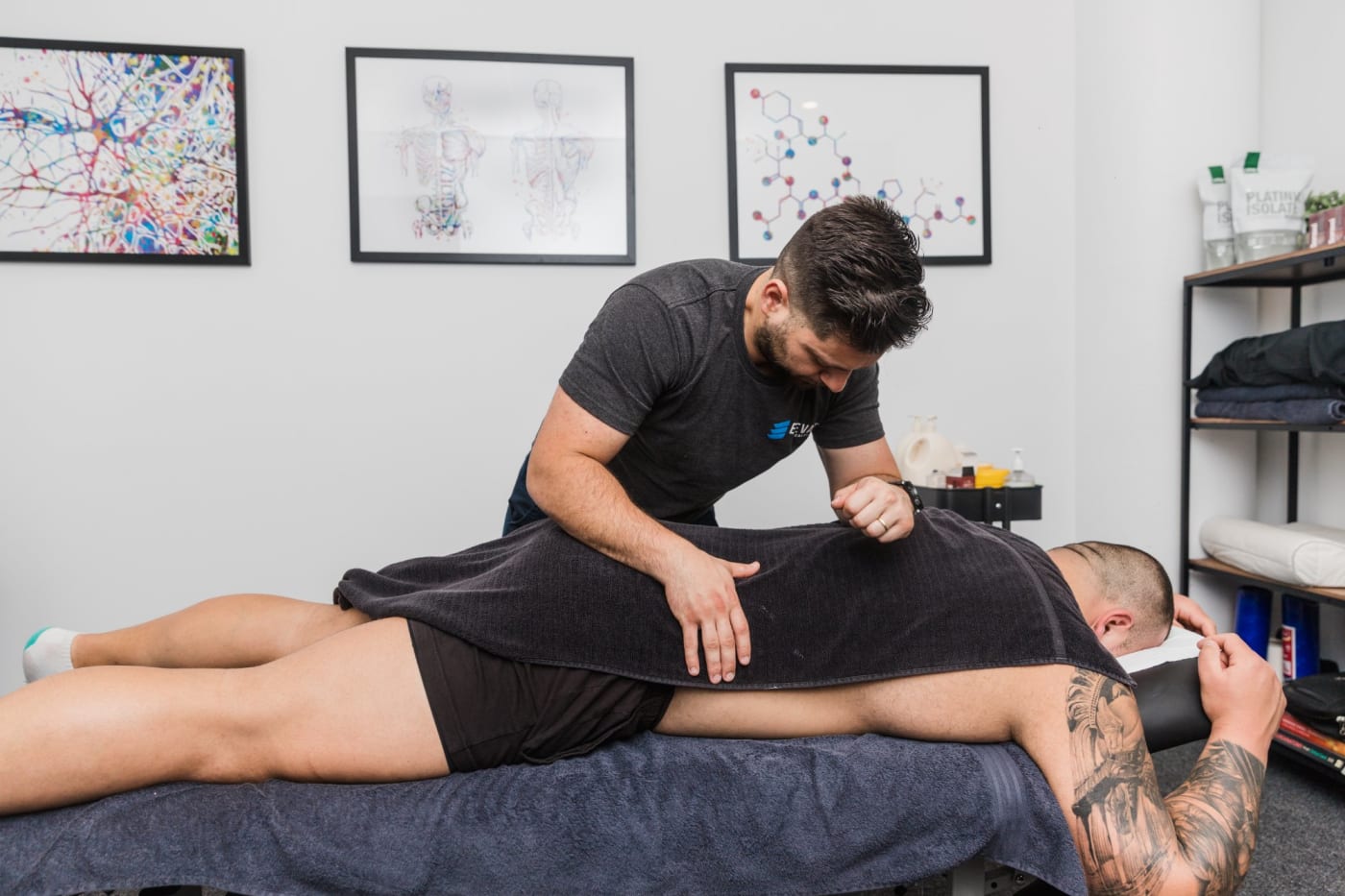
A single assessment with an accredited exercise physiologist can identify your specific movement deficits, select exercises appropriate to your pain pattern and build a progressive programme that takes you from initial management through to long-term resilience. Combined with chiropractic management of the hands-on component, this integrated approach consistently produces better long-term outcomes than exercise or manual therapy alone. Same-day appointments are available at our Bella Vista and Earlwood clinics — no referral required.
Our exercise physiology team in Bella Vista designs individualised back pain programmes based on your specific deficits and goals. For a broader explanation of why exercise is so central to back pain management, see our article on why exercise is recommended for back pain. Understanding how to exercise safely with pain is also an important part of beginning rehabilitation confidently.
Frequently Asked Questions
What is the single best exercise for lower back pain?
There is no single best exercise — the most effective programme is one tailored to your specific deficits and progressively loaded over time. However, walking is one of the most consistently well-supported interventions: it activates deep stabilisers, promotes disc nutrition through cyclic loading, and is accessible to almost everyone. It is a good starting point for most patients.
Is walking good for lower back pain?
Yes. Walking is among the most evidence-supported interventions for lower back pain. It activates spinal stabilisers, promotes disc hydration through rhythmic loading, and helps reduce fear-avoidance behaviour. Twenty to thirty minutes daily at a comfortable pace is a useful general target.
Should I avoid heavy lifting with lower back pain?
Not necessarily — and not indefinitely. Avoiding all loading perpetuates deconditioning and sensitisation. The goal is graded exposure: beginning with loads well within your current tolerance and progressively increasing. A clinician can guide appropriate return to lifting based on your specific presentation.
References
- Hayden JA, et al. (2005). Exercise therapy for treatment of non-specific low back pain. Cochrane Database of Systematic Reviews, (3).
- Searle A, et al. (2015). Exercise interventions for the treatment of chronic low back pain. Clinical Rehabilitation, 29(12), 1155–1167.
- Wai EK, et al. (2010). Causal assessment of occupational bending or twisting and low back pain. Spine Journal, 10(1), 76–88.
Ready to Get Started?
Book an appointment with our experienced team — same-day availability, NDIS, WorkCover & private health welcome.
Book an Appointment