
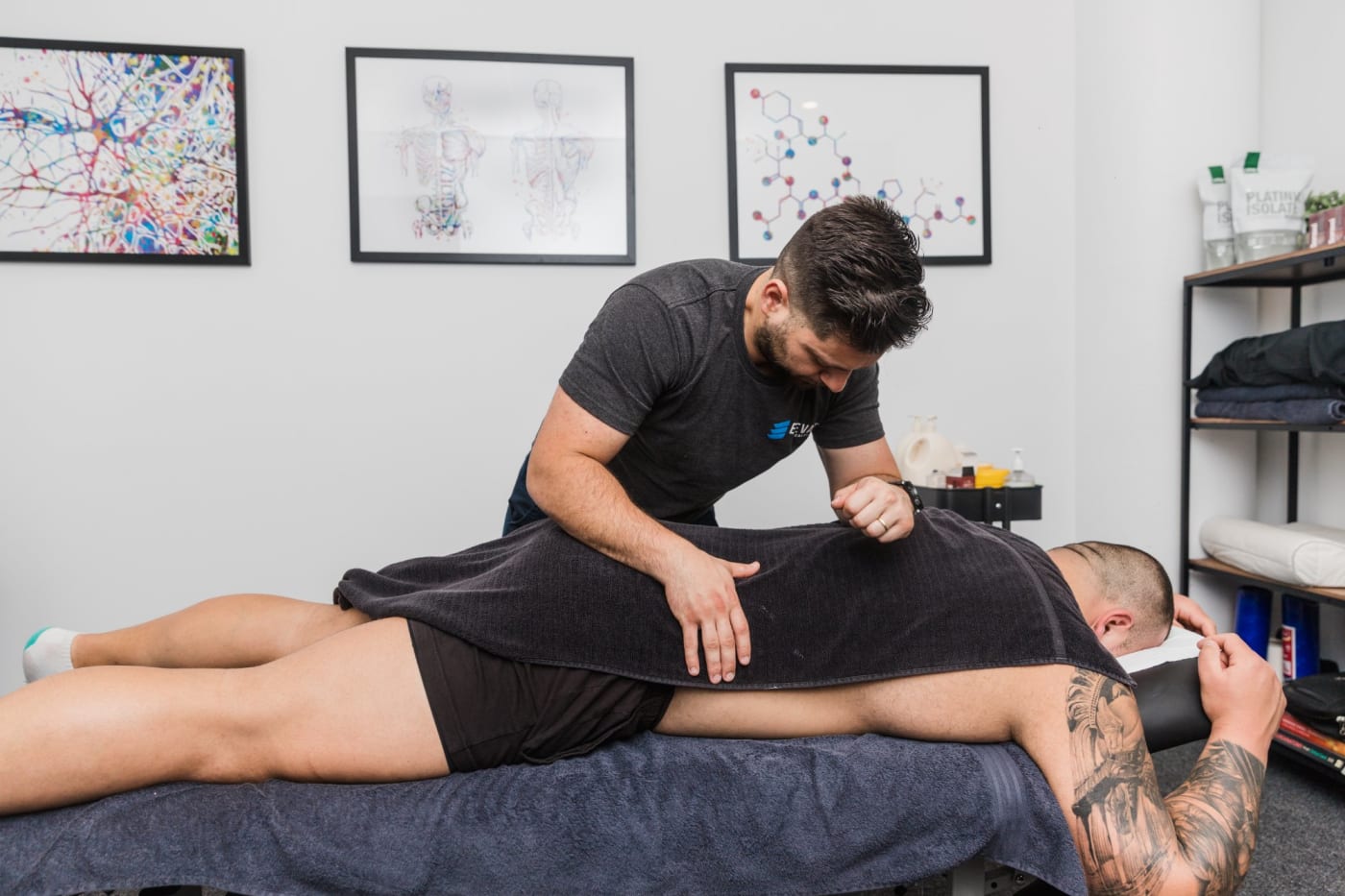
"Is cracking your back bad for you?" is one of the most common questions we hear in clinic. The short answer is: it depends on how you're doing it and why. Here's what the evidence actually says.
What Is the "Crack" Sound?
The popping sound when you crack your back is called cavitation — the same mechanism behind cracking your knuckles. Inside each joint is synovial fluid containing dissolved gases. When the joint is quickly stretched, pressure inside drops, causing a gas bubble to form and collapse. It is not bones grinding or tendons snapping — nothing is being damaged.
Is Self-Cracking Harmful?
For most people, the occasional self-manipulation is harmless. Research on knuckle cracking shows no association with arthritis or joint damage even after decades of regular cracking. The same principle applies to spinal self-manipulation. However, there are important nuances:
- Hypermobility: If you have joint hypermobility, repeatedly cracking the same joints can reinforce excessive movement rather than addressing the underlying stiffness.
- Neck cracking: The cervical spine houses major arteries. Aggressive self-manipulation of the neck carries more risk than gentle rotation or manipulation by a trained chiropractor.
- Masking pain: If you feel compelled to crack your back frequently for relief, that's a sign of underlying joint dysfunction worth addressing properly.
How Is a Chiropractic Adjustment Different?
A chiropractic adjustment is targeted, controlled and specific. Your chiropractor identifies the precise joint that is restricted and applies a measured force to that specific segment. Self-cracking is non-specific — you tend to crack whatever is most mobile, not necessarily the joint that's causing the problem. This is why self-cracking gives temporary relief but doesn't resolve the underlying issue.
When to See a Chiropractor
If you find yourself needing to crack your back multiple times daily for relief, it's worth booking an assessment. Frequent cracking urges typically indicate areas of restricted mobility causing compensatory hypermobility in adjacent segments — something a chiropractor can assess and address properly.
Need help with this? Our team at Elevate Health Clinic in Bella Vista and Earlwood can assess and treat this condition. Book online or call us today.
If you find yourself regularly needing to crack your back for relief, it is worth having a proper assessment. Our chiropractors in Bella Vista can identify what is driving the discomfort and develop a plan that addresses the cause. Our guide on what a chiropractic adjustment actually involves explains the clinical process in more detail, and our article on why back pain keeps coming back covers why symptom-management alone rarely produces lasting results.
Why Does Cracking Your Back Feel Good?
The temporary relief many people experience after self-manipulating their back has a neurophysiological explanation. The rapid joint movement stimulates mechanoreceptors within the joint capsule, which activates inhibitory interneurons in the spinal cord — briefly suppressing pain signal transmission through a mechanism similar to the gate control theory of pain. It also produces a rapid relaxation of the surrounding musculature via the Golgi tendon reflex, which reduces the local muscle guarding that was contributing to the stiffness and discomfort.
These effects are real — but they are temporary. The underlying joint dysfunction or muscle tension that drove the urge to crack is not addressed by the self-manipulation. This is why many people find themselves repeatedly cracking the same segment throughout the day: the relief lasts 20–30 minutes, the tension returns, and the cycle repeats. It is a symptom management behaviour, not a treatment.
The Problem with Habitual Self-Manipulation
For most people, occasional self-cracking of the back is not harmful. The concern arises with habitual, repeated manipulation of the same spinal segments over months or years. Several mechanisms may explain why this becomes counterproductive over time:
- Joint hypermobility — repeatedly stretching the same joint capsule and surrounding ligaments can increase local laxity. The joint becomes increasingly easy to manipulate but loses some of its structural stability, which the surrounding muscles then work harder to compensate for — contributing to the chronic tension that drove the behaviour in the first place.
- Adjacent segment load — habitual manipulation tends to target the most mobile (not the most restricted) segments. The joints that genuinely need mobilisation — the stiff, dysfunctional ones — remain unaddressed, while the already-mobile segments are repeatedly stressed.
- Avoidance of assessment — the temporary relief from self-cracking can mask a complaint that warrants proper assessment and management. Patients who self-manage for months before seeking care often present with more entrenched dysfunction than those who sought early assessment.
When Cracking Becomes a Red Flag
Occasional self-cracking is generally benign. But certain presentations warrant prompt clinical assessment rather than continued self-management:
- Cracking or popping accompanied by sharp pain, rather than relief
- Grinding or crepitus (a continuous rough sensation) rather than a clean pop
- Cracking that is becoming necessary more frequently for the same level of relief
- Associated symptoms — radiating pain, numbness, weakness or headaches
- A compulsion to crack that is interfering with daily function or focus
If any of these apply, a clinical assessment at our Bella Vista chiropractic clinic can identify the underlying driver and provide a more effective and lasting approach than continued self-manipulation. Most patients are surprised at how quickly the urge to crack resolves once the actual joint dysfunction has been properly addressed.
Frequently Asked Questions
Is it bad to crack your own back?
Occasional self-manipulation of the back is not associated with significant harm in most people. However, if you feel a persistent compulsion to crack your back for relief, this often indicates an underlying musculoskeletal issue that is worth assessing properly. A clinician can address the root cause rather than you managing symptoms through repeated self-manipulation.
Does cracking your back cause arthritis?
No. There is no reliable evidence that cracking joints — in the back or elsewhere — causes arthritis. The cracking sound is caused by gas bubble cavitation in the synovial fluid, not by bone or cartilage damage.
What is the difference between cracking your own back and a chiropractic adjustment?
A chiropractic adjustment is a specific, controlled force applied to a targeted joint in a particular direction to restore normal movement. Self-manipulation is non-specific and cannot replicate the precision of a clinical adjustment. In some presentations, self-manipulation may temporarily relieve discomfort — but it does not address the underlying dysfunction.
References
- Deweber K, et al. (2011). Knuckle cracking and hand osteoarthritis. Journal of the American Board of Family Medicine, 24(2), 169–174.
- Brodeur R. (1995). The audible release associated with joint manipulation. Journal of Manipulative and Physiological Therapeutics, 18(3), 155–164.
- Dunning J, et al. (2012). Upper cervical and upper thoracic thrust manipulation versus nonthrust mobilization in patients with mechanical neck pain. Journal of Orthopaedic & Sports Physical Therapy, 42(1), 5–18.
Ready to Get Started?
Book an appointment with our experienced team — same-day availability, NDIS, WorkCover & private health welcome.
Book an Appointment