
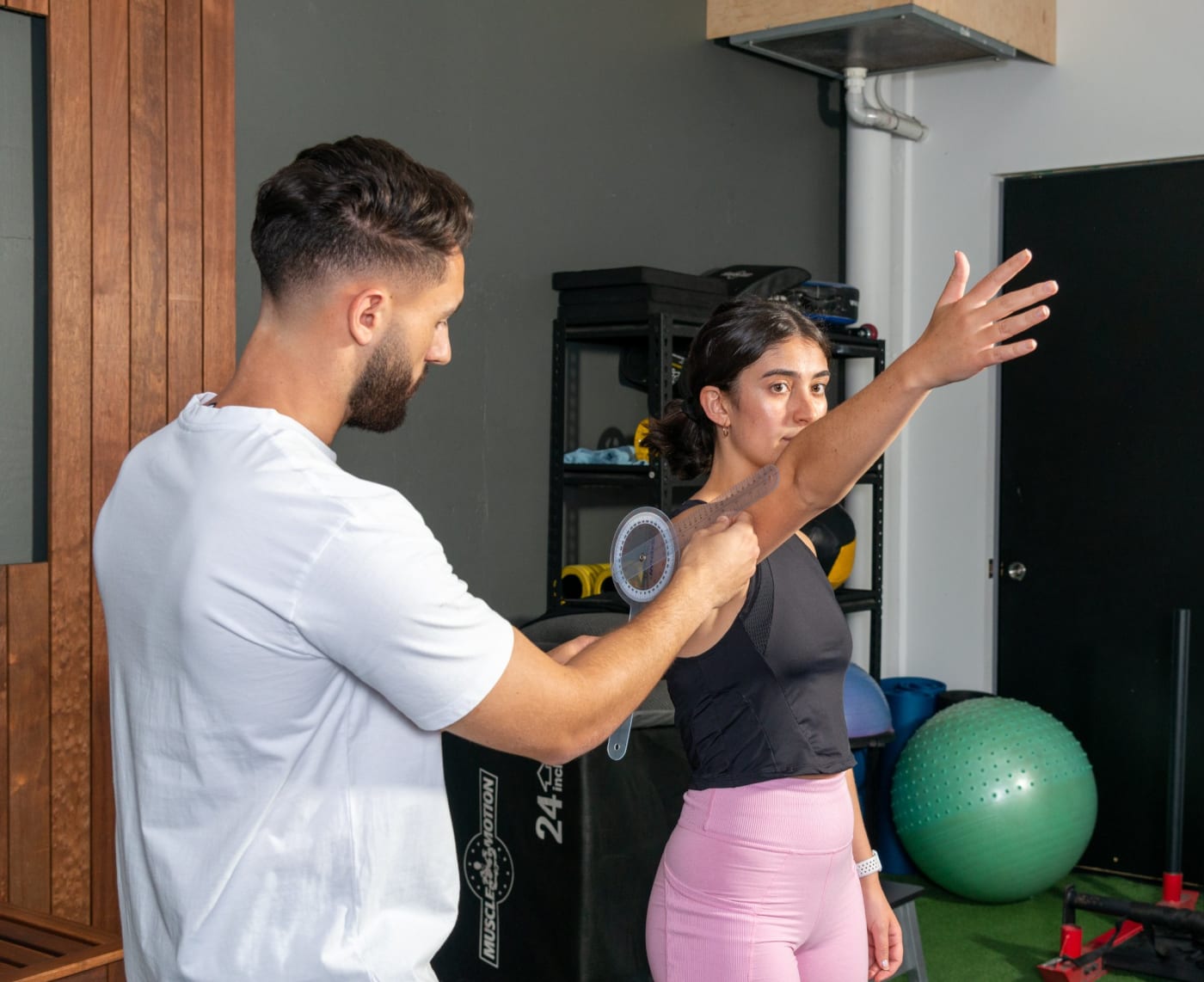
You've noticed it getting harder to reach overhead. Pulling on a seatbelt hurts. Lying on your shoulder at night wakes you up. When you raise your arm to the side, somewhere between 60 and 120 degrees, there's a sharp pain — then it eases off as you lift higher.
That's the classic presentation of shoulder impingement — and it's the most common shoulder complaint we see in clinic. The good news: with the right rehabilitation approach, the majority of shoulder impingement cases resolve completely without surgery.
Quick answer — shoulder impingement:
- Caused by the rotator cuff tendons and bursa being compressed in the subacromial space
- The "painful arc" — pain between 60 and 120 degrees of elevation — is the hallmark sign
- Most commonly caused by rotator cuff weakness and poor scapular control
- Exercise rehabilitation is the primary treatment and is as effective as surgery
- Recovery typically takes 6–12 weeks with appropriate management
What Is the Subacromial Space?
To understand shoulder impingement, you need a brief anatomy lesson.
The shoulder joint (glenohumeral joint) is a ball-and-socket joint with the greatest range of motion of any joint in the body. Between the top of the shoulder (the acromion) and the rotator cuff tendons below is a narrow space called the subacromial space — typically about 9–10mm wide.
Within this space sits the subacromial bursa — a fluid-filled sac that lubricates the tendons as they slide under the acromion during arm elevation.
Shoulder impingement occurs when this space narrows, causing the rotator cuff tendons (particularly the supraspinatus) and bursa to be mechanically compressed (impinged) as the arm is raised. Repeated impingement causes inflammation, thickening of the tendon and bursa, and pain.
Why Does the Space Narrow?
Rotator Cuff Weakness (The Primary Cause)
The rotator cuff's primary function — beyond rotation — is to compress the humeral head into the glenoid (the socket). When the cuff muscles fatigue or weaken, the humeral head migrates slightly upward during arm elevation, narrowing the subacromial space. This is the most common and most treatable cause of impingement.
Scapular Dyskinesis
Normal shoulder mechanics require the scapula (shoulder blade) to rotate upward as the arm elevates — tilting the acromion upward and opening the subacromial space. When scapular movement is disrupted (dyskinesis), the acromion doesn't lift adequately, and the space closes. Poor scapular control is almost universally present in shoulder impingement.
Postural Factors
Forward head posture and rounded shoulders (thoracic kyphosis) alter shoulder mechanics by reducing the available upward rotation of the scapula. This is particularly relevant for desk workers and those with prolonged computer use.
Structural Factors
A hooked (Type III) acromion shape — a natural anatomical variant — reduces the subacromial space structurally. Calcification within the supraspinatus tendon can also reduce available space. These structural factors are less modifiable but don't preclude conservative management.
Symptoms and Diagnosis
Classic Symptoms
- Painful arc — pain specifically between 60 and 120 degrees of arm elevation (reducing above 120 degrees)
- Pain on the outer or front of the shoulder, sometimes radiating to the upper arm
- Pain reaching behind the back (e.g. fastening a bra, tucking in a shirt)
- Night pain, particularly when lying on the affected shoulder
- Weakness with overhead activities or lifting
Clinical Tests
Your chiropractor or physiotherapist will perform specific provocative tests including the Hawkins-Kennedy test, Neer's sign and the Empty Can test — each of which stresses the subacromial space in a specific way. A thorough assessment also includes evaluation of scapular control, rotator cuff strength and cervical spine contribution.
Treatment — What the Evidence Says
A 2019 meta-analysis published in the British Journal of Sports Medicine found that supervised exercise rehabilitation produced outcomes equivalent to subacromial decompression surgery for shoulder impingement at 12-month follow-up. Surgery is no longer considered the first-line treatment for most cases.
Phase 1: Pain Reduction and Movement Restoration
- Activity modification — temporarily avoiding overhead activities that reproduce symptoms
- Manual therapy to the shoulder, acromioclavicular joint and thoracic spine
- Dry needling to the rotator cuff and upper trapezius if indicated
- Taping to support scapular position and reduce symptom provocation
Phase 2: Rotator Cuff Strengthening
The foundation of shoulder impingement rehabilitation. Specific focus on the posterior rotator cuff — the infraspinatus and teres minor — which are the most commonly weak and under-loaded muscles in impingement presentations.
- Side-lying external rotation — the most specific posterior cuff exercise
- Standing band external rotation
- Prone T, Y and W exercises for posterior cuff and scapular retractors
- Sidelying inferior glide — manual therapy technique to address superior humeral migration
Phase 3: Scapular Control and Overhead Loading
- Serratus anterior activation (wall push-up plus, protraction exercises)
- Lower trapezius strengthening (prone Y raise)
- Progressive overhead loading as pain allows
- Return to sport or work-specific activities
Exercise Rehabilitation for Shoulder Impingement
Exercise is the cornerstone of shoulder impingement rehabilitation — and the evidence clearly supports this. A landmark randomised controlled trial published in the BMJ found that a structured 12-week exercise programme produced outcomes equivalent to surgery for subacromial impingement, with fewer complications and lower cost. Subsequent systematic reviews have reinforced this finding: most patients with shoulder impingement respond well to conservative management, and surgery should be reserved for the minority who do not.
The key components of an evidence-based shoulder rehabilitation programme are:
- Rotator cuff strengthening — particularly the external rotators (infraspinatus and teres minor) and lower trapezius, which are almost universally weak in impingement presentations.
- Scapular stabilisation — restoring normal scapular upward rotation and posterior tilt, which directly increases the subacromial space during arm elevation.
- Posterior capsule stretching — tight posterior capsule is a common contributing factor to impingement; the sleeper stretch and cross-body stretch are specifically effective.
- Load management — modifying activities that provoke symptoms (particularly internal rotation under load) while maintaining overall fitness and function.
Exercise prescription must be individualised based on which structures are involved, the patient's activity level and their response to treatment. A programme that works well for a desk worker with mild impingement may be completely inappropriate for an overhead athlete with rotator cuff involvement. Our exercise physiology team and sports chiropractors design shoulder rehabilitation programmes tailored to your specific presentation, sport and goals.
Frequently Asked Questions
How long does shoulder impingement take to heal?
With appropriate rehabilitation, most shoulder impingement cases improve significantly within 6–8 weeks and resolve fully within 3–4 months. Cases with concurrent rotator cuff tendinopathy or significant structural factors may take longer.
Should I avoid the gym with shoulder impingement?
You don't need to stop training — but you need to modify. Overhead pressing, upright rows and behind-the-neck exercises should be avoided during the acute phase. Horizontal pushing (bench press) can often be continued with technique modification. Your physiotherapist or chiropractor will guide activity modification specific to your training program.
Does shoulder impingement require surgery?
Surgery (subacromial decompression arthroscopy) is rarely necessary and should only be considered after a full course of supervised conservative rehabilitation has failed. The evidence shows that rehabilitation and surgery produce equivalent outcomes for most cases — and rehabilitation avoids surgical risk and a longer recovery period.
Can shoulder impingement come back after treatment?
It can recur if the underlying contributors — rotator cuff weakness, poor scapular control, postural habits — aren't addressed comprehensively. This is why rehabilitation should continue until you're stronger than you were before the injury, not just until you're pain-free.
Need help with this? Our team at Elevate Health Clinic in Bella Vista and Earlwood can assess and treat this condition. Book online or call us today.
Shoulder impingement is one of the most common presentations our sports chiropractic team manages. For a broader discussion of how injury rehabilitation progresses from hands-on treatment to independent management, see our guide on why injuries keep coming back. Our exercise physiology team designs progressive rotator cuff and scapular programmes to rebuild shoulder capacity and reduce recurrence risk.
References
- Holmgren T, et al. (2012). Effect of specific exercise strategy on need for surgery in patients with subacromial impingement syndrome. BMJ, 344, e787.
- Hanratty CE, et al. (2012). The effectiveness of physiotherapy exercises in subacromial impingement syndrome. Seminars in Arthritis and Rheumatism, 42(3), 297–316.
- Bron C & Dommerholt JD. (2012). Etiology of myofascial trigger points. Current Pain and Headache Reports, 16(5), 439–444.
- Diercks R, et al. (2014). Guideline for diagnosis and treatment of subacromial pain syndrome. Acta Orthopaedica, 85(3), 314–322.
Ready to Get Started?
Book an appointment with our experienced team — same-day availability, NDIS, WorkCover & private health welcome.
Book an Appointment